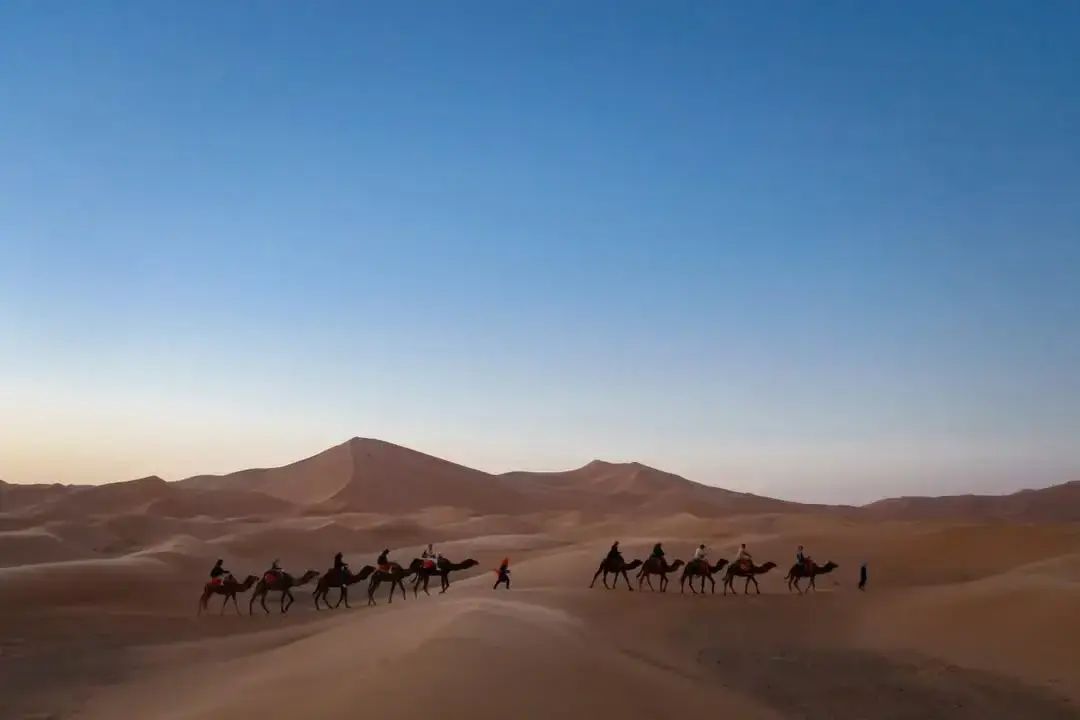
How to Choose a Sahara Desert Camp
Camps around Erg Chebbi go from simple shared tents to roomy private suites. Six steps and a short checklist to find the one that suits your trip.
Published · 4 min read

Choosing a Sahara desert camp is the decision that shapes your night in Merzouga more than any other. Around Erg Chebbi you'll find simple shared tents and spacious private suites, camps a short drive from the road and remote spots you can only reach by camel.
There's no "best" camp. There's the one that matches your budget, the comfort you need and the way you like to travel. These six steps will get you there.
Step 1: Set a realistic budget
Prices move a lot with the type of tent, the season, your group size, and which transfers and activities are included. Before you compare anything, decide roughly what you want to spend per night, all included, and whether that figure should cover the camel ride, dinner and transfers.
Two offers with very different prices often include very different things, so compare like with like. We go into the trade-offs in our article on luxury vs. standard desert camps.
Step 2: Decide how much comfort you need
This is where camps differ most. For one or two nights, what do you actually care about?
Bathrooms
- Shared bathrooms are normal in simpler camps.
- Private bathrooms inside or attached to the tent are more common in higher-end camps, but not guaranteed, so check.
- Some very simple or remote set-ups only have basic toilet facilities.
Beds and space
Most camps have proper beds with blankets. Simpler ones may use mattresses on a low base. Tents range from just enough room to sleep to a small room with seating.
Heating, cooling and electricity
In winter, desert nights can get close to freezing. In summer they stay very warm. Heating, fans or air conditioning depend on the camp and the season, so don't assume anything: ask what's available on your dates. Power may be solar, only on in the evening, or limited to charging points in a shared area.
Step 3: Think about location and access
Some camps are more "in the dunes" than others.
- How far into the dunes: some camps sit at the edge of Erg Chebbi, others further in, where you feel much more cut off.
- Camel or 4x4: many camps can be reached either way. For most people the sunset camel ride in is part of the experience. A 4x4 transfer is better if you can't ride or have heavy bags.
- Luggage: if you go in by camel, you'll normally take a small overnight bag and leave big luggage in a vehicle or at a guesthouse. Ask how it works.
Step 4: Consider group size and privacy
Some camps have a handful of tents, others are set up for lots of guests. Ask yourself:
- Do you want a lively shared dinner with music round the fire, or peace and quiet?
- Are you a couple, a family or a group of friends?
- Would you like a private camp or a private tent area, if one is available?
If you want real seclusion, a wild camp is simpler and more remote. The operator sets it up in a suitable area with the necessary local permissions.
Step 5: Food and dietary needs
Dinner is usually Moroccan: soup, tajine or couscous, fruit and mint tea, then a simple breakfast in the morning. Most camps can cook for vegetarians, and many will try to handle allergies or other diets if you tell them in advance.
If your needs are strict (coeliac disease, severe allergies, vegan), put them in writing when you enquire and ask how they'll be handled. Desert kitchens are basic and supplies come in by vehicle.
Step 6: Check exactly what is included
What's included varies a lot between operators and packages. Things to pin down:
- Camel ride in and out, or 4x4 transfer
- Dinner and breakfast; drinks
- Sandboarding, music or other activities
- Transfers from your hotel, from Merzouga village or from another city
- Parking or luggage storage
Questions to ask before booking a desert camp
Whoever you book with, these questions save surprises:
- What exactly is included: meals, transfers, activities?
- What kind of bathroom will we have: private, shared or basic?
- Is there heating or cooling on our dates?
- How do we get to the camp, and how long does it take?
- Where does our main luggage stay overnight?
- Can you cater for our diet?
- What are your cancellation and bad-weather terms?
- How big is the camp, and can we have some privacy?
A good operator answers clearly and puts the key points in writing.
Quick decision checklist
- Budget set per night, with offers compared like for like
- Bathroom type confirmed
- Heating or cooling checked for your season
- Access by camel or 4x4 agreed, and luggage sorted
- Group size and privacy right for you
- Diet sent in writing
- Cancellation terms understood
Which camp type might suit you?
- Comfort first: a luxury desert camp usually has bigger tents and more amenities, depending on the camp.
- Good value, the essentials covered: a standard desert camp is simple and sociable.
- Silence and simplicity: a wild camp for a quieter, more remote night with the bare minimum.
- Desert life up close: a nomad camp with a host family, where conditions are basic.
You can see every option side by side on our desert camps page.
Ready to choose?
Still not sure? Send us your dates, your group and what matters most through the custom tour form, or contact us with your questions. We'll suggest a few camps and confirm what's included in writing before anything is booked.
Learn more
Background reading on Wikipedia and more packages on our other site.